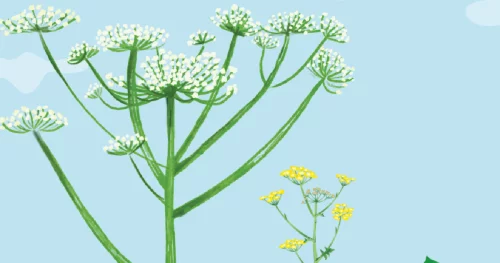
WATCH WHERE YOU STEP!
Are you a fan of hiking, wide open spaces and peaceful walks in nature?
The physical and mental benefits of walking in nature have been scientifically proven. Disconnecting from the hustle of urban life and daily stress is excellent for calming the mind and reducing anxiety. Regularly getting fresh air also strengthens the immune system, lowers blood pressure and improves cognitive abilities.
Some plants, however, can quickly spoil your experience. Among the varieties most likely to cross your path are giant hogweed, wild parsnip and poison ivy. Simple skin contact can be enough to cause very unpleasant effects.
Becoming familiar with these plants and being attentive to the environment around you will help you enjoy pleasant and beneficial moments in nature.
This harmful plant is found throughout the province in cool, moist soil conditions, such as in ditches, fields and along the banks of waterways.
Measuring between 2 and 5 m in height, giant hogweed certainly does not go unnoticed.
Why is this plant considered toxic?
The sap of this plant contains phototoxic toxins. In other words, within 48 hours of skin contact with the sap combined with exposure to light, sometimes severe lesions appear.
In case of skin contact:
In case of contact with the eyes:
This toxic invasive species belongs to the same family as giant hogweed. Wild parsnip is found along the edges of fields, roads and railway tracks, as well as in fields and ditches.
Smaller than giant hogweed, this plant measures between 0.5 and 1.5 m tall.
Does wild parsnip cause the same symptoms as giant hogweed?
The sap of this plant also contains phototoxic toxins that can cause severe dermatitis. However, these lesions are generally mild compared to those caused by hogweed.
In case of skin contact:
This plant adapts to various environments. It can therefore be found almost anywhere, such as along trails and nature paths, in woods and waterways, and on vacant lots.
Poison ivy is a shrubby or sometimes climbing plant, measuring from 20 cm to 1 m in height.
Why avoid this plant?
Poison ivy is a toxic plant whose sap, composed of a toxin called urushiol, can cause a strong allergic skin reaction. The reaction can occur after direct contact with the plant, an object soiled by the sap, or through inhalation of the toxic fumes produced by burning the plant*.
*Note that burning poison ivy "can cause extremely painful inflammation of the lungs and serious respiratory problems that can lead to death" (Gouvernement du Québec, 2021c).
In case of skin contact:
*Consult a doctor immediately if you have inhaled smoke from burning poison ivy plants or if you have accidentally ingested the sap.
To relieve symptoms
*Consult a doctor if symptoms are severe, widespread or located in a sensitive area (face, eyes, genital area, etc.) and if there are signs of infection (increased pain, pus, fever, etc.).
How can you tell the difference between poison ivy and ragweed?
These 2 plants are often confused. However, they can be distinguished by their appearance and their effects on health.
Visual differences
While poison ivy has shiny foliage, with each leaf composed of 3 pointed leaflets, ragweed has rather jagged foliage resembling that of a carrot.
As mentioned above, poison ivy causes a severe skin reaction on contact with its sap. Ragweed, on the other hand, is harmless to the touch, but produces an airborne pollen that can cause an allergic reaction. It is one of the main causes of seasonal allergic rhinitis, also known as hay fever.
Gouvernement de l'Ontario. July 23, 2015. "Fiche d'information sur le panais sauvage". https://fr.scribd.com/document/272371113/Fiche-sur-le-panais-sauvage#from_embed
Gouvernement du Québec. 2021a. "Brûlage de la berce du Caucase". https://www.quebec.ca/sante/problemes-de-sante/a-z/brulures-causees-par-la-berce-du-caucase
Gouvernement du Québec. 2021b. "Reconnaître et éliminer la berce du Caucase". https://www.quebec.ca/habitation-et-logement/milieu-de-vie-sain/reconnaitre-et-eliminer-la-berce-du-caucase
Gouvernement du Québec. 2021c. "Réactions allergiques causées par l'herbe à puce". https://www.quebec.ca/sante/problemes-de-sante/a-z/allergies-causees-par-l-herbe-a-la-puce
Gouvernement du Québec. 2021d. "Reconnaître et éliminer l'herbe à la puce". https://www.quebec.ca/habitation-et-logement/milieu-de-vie-sain/reconnaitre-et-eliminer-l-herbe-a-la-puce
Morita, E., Fukuda, S., Nagano, J., Hamajima, N., Yamamoto, H., Iwai, Y., Nakashima, T., Ohira, H. and Shirakawa, T. 2007. "Psychological effects of forest environments on healthy adults: Shinrin-yoku (forest-air bathing, walking) as a possible method of stress reduction". Public health, 121(1), 54-63. https://pubmed.ncbi.nlm.nih.gov/17055544
Tsunetsugu, Y., Park, B. J. and Miyazaki, Y. 2010. "Trends in research related to 'Shinrin-yoku' (taking in the forest atmosphere or forest bathing) in Japan". Environmental health and preventive medicine, 15(1), 27-37. https://doi.org/10.1007/s12199-009-0091-z
Québec. 2021. "Panais sauvage". https://www.ville.quebec.qc.ca/citoyens/environnement/arbres-plantes/plantes-nuisibles-et-dangereuses/panais-sauvage.aspx
Communications Officer
- Its large, sturdy trunk has dark red spots and coarse white hairs.
- Its serrated foliage can reach 1.5 m wide by 3 m long.
- Its umbrella-shaped white flowers measure 25 to 50 cm in diameter.
- Redness and swelling of the skin
- Blisters
- Minor or, more rarely, severe burns (1st or 2nd degree)
- Remove the sap quickly with absorbent paper, without rubbing.
- Rinse the area and wash with soap.
- Wash clothing immediately.
- Avoid exposing the area to light and protect it for at least 48 hours, or 1 week in case of burns.
- Apply sunscreen with a minimum SPF of 30 for 6 months to protect from UV rays.
- Rinse thoroughly for at least 10 minutes.
- Avoid exposure to light by wearing sunglasses with dark lenses.
- Consult a doctor promptly.
- Its thick stem is green and smooth. Like hogweed, it has hairs, but in smaller quantities.
- Its serrated leaves are composed of 2 to 5 pairs of leaflets (small leaves) "growing opposite each other on the stem, with a diamond-shaped leaflet at the tip" (Gouvernement de l'Ontario, 2015).
- Its yellowish-green umbrella-shaped flowers measure 10 to 20 cm in diameter.
- Wash the affected area with soap, then rinse thoroughly with clean water.
- Wash your hands.
- Wash clothing if it has been in contact with the plant.
- Avoid exposing the area to light and protect it for at least 48 hours, or 1 week in case of burns.
- Put on the necessary protective equipment (goggles, long clothing, gloves, rubber boots).
- Pull up the plant by removing as much of the taproot as possible using a round shovel, a spade or a long-handled knife.
- Cover the infested area with a geotextile fabric after cutting the roots and stems to prevent regrowth, or perform regular monitoring to remove any regrowth.
- Wash your clothes and tools.
- For large infestations, professional extermination is preferable.
- The best time to remove this plant is in spring, when the soil is moist.
- Do not burn or compost wild parsnip plants.
- Each leaf is composed of 3 pointed leaflets.
- Its shiny foliage changes color with the seasons. It is reddish in spring, green in summer, then varies from yellow to orange and red in autumn.
- During flowering, in June and July, clusters of small cream or yellow flowers appear under the leaves of the plant.
- Symptoms appear within 24 to 48 hours after contact.
- Intense itching
- Sensation of pain or burning
- Redness and swelling of the skin
- Blisters
- Wash the affected area with cold water and a mild soap as soon as possible.
- Wash all clothing that has been in contact with the plant (including shoes, socks and laces).
- Be careful to remove any pieces of the plant that may have become lodged under your nails.
- Avoid rubbing too vigorously.
- Apply cold water and baking soda compresses.
- Take lukewarm baths with colloidal oatmeal powder.
- Consult a pharmacist to obtain the treatment best suited to your needs.